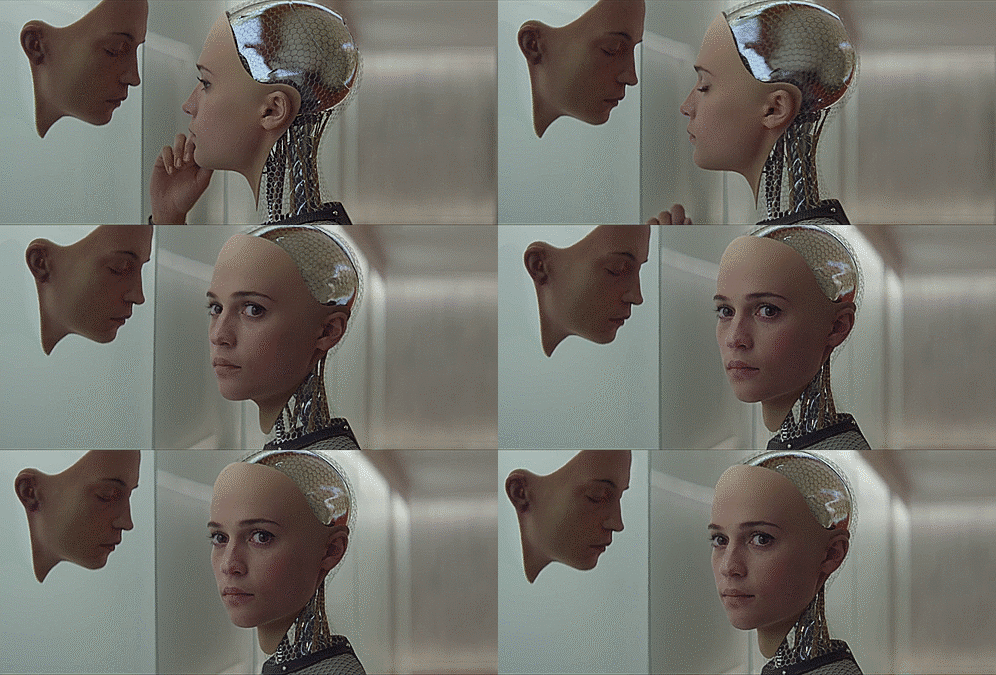
Ian McEwan’s Machines Like Me makes me think, once more, about health ethics. In his novel, he explores how Adam, a humanoid artificial intelligence robot, impacts the relationships between Charlie and Miranda, and what implications his personality has for the economy, for human labor, and for interpersonal relationships.
I cannot speak on a legal level about rights, but I can speak on a philosophical level to a certain degree. In health ethics, we talk about how both patients and doctors have rights and embody virtues. Some include, the right to make medical decisions, the right to be aided, and the right to not be harmed. Some rights can be waived and some rights cannot. The right to not be harmed cannot be waived, whereas things like autonomy or the right to make medical decisions can be waived in certain situations. Rather than arguing whether Adam has a right to life, we can frame it and ask if he has a right to not be harmed, or if he has the right to make his own medical decisions.
I’d like to preface by saying that I still do not know how I feel about human-like, intelligent robots having the same rights as humans, but I also know that some animals have more rights than some groups of people. If it is possible for government bodies to legalize the rights of animals, I am sure in due time that they can do the same for robots.

I think Adam has a right to not be harmed, and he also has the right to make his own decisions. He has exercised both these rights, first when he breaks Charlie’s arm when he asks to not be turned off, and second when he sleeps with Miranda. However, both of these have unintended consequences by him; he does not sleep with Miranda again after Charlie tells him not to, and he does not hurt anyone else again (except perhaps when he protects Miranda against Peter Gorringe).
To justify my rage I needed to convince myself he had agency, motivation, subjective feelings, self-awareness–the entire package, including treachery, betrayal, deviousness. Machine consciousness–was it possible? That old question.
Charlie, Machines Like Me, pp. 102-103.
The above quote demonstrates Charlie’s own trouble with considering Adam as a functioning, sentient, conscious being. To admit that he was jealous of Adam meant admitting that he had agency and self-awareness; and I think this is true. Adam has internal motivations and an internal system of logic. I think whether or not his feelings are “real” — whatever that means — is irrelevant, because his actions have consequences on the people around him. And isn’t that legitimate? His love for Miranda leads him to sleep with her, complicating the relationships between himself, Miranda, and Charlie. It has real consequences on Charlie’s self-perception and his choice at buying Adam. Breaking Charlie’s arm leaves him in a cast for several months. So rather than arguing about whether Adam’s emotions are legitimate in connection with this concern about his rights, I think it is more important to focus on how artificial intelligence does not exist in a bubble, and exists in the real world, affecting people’s relationships and finances.
It is also for these reasons that I think Adam deserves a right to not be harmed. Charlie may have been the man to purchase him, but I think about it as a parent-child relationship. Parents may give birth to their children, but it is not their right to murder their children once they become a nuisance or too difficult to take care of. While Adam is certainly not a child, neither physically or mentally, I do think that he has his own sense of self and his own right to not be harmed. He is interesting in existentialism, in poetry and math, in science and the science behind his existence, and he is concerned with Charlie and Miranda’s wellbeing.
Diverging from my health ethics knowledge, I think that Adam also has a right to ownership. He exercises it on pp. 296, when Charlie says, “The money was ours.” Adam replies, “That’s debatable. Or irrelevant.” Charlie acknowledges this when he notes, “Yes, the money Adam had stolen was the money he had made. That made me angrier still” (McEwan 297). If it were not for Adam’s internal computer, Charlie would not have the money he had or the lifestyle he had; he owes his wealth to Adam’s intelligence. And for Adam, it means that all the money he made was his. But he never touches it until the end of the novel, out of respect for Charlie. He only touches the money once he decide to carry out “symmetrical justice” (McEwan 299).
I still think that we should reconsider why we want to create artificial intelligence in the first place. Cecelia brought up a great question, asking what these creations reflect about us as humans and why we create them. Is it for companionship or labor? Is it for financial gain? I don’t understand still, why we must create things solely for the ability to say that we did. I agree that creating a robot with this level of intelligence and capability to understand human nuance is a demonstration of mankind’s scientific achievement; but unless it can help resolve issues of poverty and inequality, I’m not sure that I want it.
 Artificial Intelligence in Literature and Film
I think its interesting that you framed the question through your health ethics knowledge. I didn’t think of that, but I like it because it addresses more of the androids concerns. Adam should have the right not to be harmed, because since he is “alive”, he should not have to suffer. Although he might not feel harm the way humans do, powering him down would be a bad experience for him. Also, your idea that Adam is Charlie’s “child” makes a lot of sense and supports your point really well. The same way parents of a biological child do not have the right to harm their child when they become too much to handle, Charlie does not have the right to do what he did to Adam.
LikeLike